
If you’ve spent the last few weeks searching sun conure price online you’ve probably noticed something frustrating. Every site quotes a different number. One says 300 dollars. Another says 1200. And nobody tells you why.Here’s the thing. Sun conure price in 2026 depends on age mutation breeder and supply. And that’s actually good news once you know what to look for. This article breaks down real 2026 prices for baby sun conures standard birds and rare mutations plus everything you need to know before you bring one home.Plain and simple. A sun conure is one of the most colorful parrots you can own. They’re also one of the loudest. Both of those things matter when you’re deciding if this is the right bird for you.
Written by Moaz at Dallas Parrots
I’m Moaz and I’ve spent over 3 years working with parrots at Dallas Parrots. Hand feeding baby sun conures watching them wean and placing them into new homes is a big part of my week.Everything in this article comes from actual experience. Not copy-paste research. I’ve talked enough buyers through the pricing process to know where the confusion hits and how to clear it up.
- 3+ years hands-on parrot care at Dallas Parrots
- Works daily with baby sun conures and other conure parrot babies
- Partners with avian vets for health screening
Sun Conure Price 2026 Overview
Let’s get straight to it. Sun conure price in 2026 runs between 400 and 1200 dollars in the USA for most buyers. Hand fed baby sun conures sit in the 500 to 900 range. Adult rehomes drop to 200 or 400. And rare mutations like red factor or yellow sun can push past 1500 depending on the breeder.Here’s the full price list for 2026.
| Type | Price range (USD) |
|---|---|
| Standard baby sun conure (hand fed) | 500 to 900 |
| Adult rehome | 200 to 400 |
| Red factor sun conure | 900 to 1400 |
| Yellow sun conure mutation | 1000 to 1500 |
| High yellow sun conure | 700 to 1100 |
| Pineapple conure (different species often compared) | 500 to 800 |
| Lutino conure mutation | 1200 to 1800 |
Pricing tends to shift a bit depending on where you are. Tennessee breeders sometimes run a bit lower than coastal states. Shipping adds another 150 to 300 dollars if the breeder offers it. You can check our currently available sun conure for sale listings to compare.
What Affects Sun Conure Price
Why does one sun conure cost 400 and another costs 1400? A few things drive the difference.Age is the first one. A hand fed sun conure chick that’s just starting to wean sells higher than a fully grown bird looking for a new owner through adoption. Hand feeding is labor-intensive and breeders factor that into the price.Mutation and rarity push prices up fast. Standard sun conures already have vibrant colorful plumage with yellow orange and red feathers. But rare color variants like red factor high yellow sun conure or the yellow sun mutation sell for way more because supply stays limited. Lutino is even rarer.
Breeder reputation matters too. A verified breeder who does DNA testing health screens every bird and hand raises from day one charges more. And honestly that’s the one you want. A cheap bird from an unknown source often comes with hidden health issues that cost you thousands at the avian vet later.Location and current supply play a role too. Tropic Island Bird and Supply in south Tennessee sometimes runs different pricing than a breeder on the west coast. Month of purchase matters also. Baby sun conures ready to go by end of April might be priced differently than a bird available in December.
What Is a Sun Conure
A sun conure is a medium-sized parrot native to northeast South America. Their scientific name is Aratinga solstitialis and they’re one of the most popular conure species in the pet trade thanks to their bright yellow and orange feathers with red highlights and green wing tips.
| Attribute | Detail |
|---|---|
| Scientific name | Aratinga solstitialis |
| Native range | Northeast South America |
| Adult size | 12 inches |
| Weight | 4 to 5 ounces |
| Lifespan | 20 to 30 years |
| Status | Endangered in the wild |
They grow to around 12 inches from beak to tail and weigh 4 to 5 ounces. Males and females look nearly identical which is why DNA sexing is standard when you buy from a good breeder.
Sun Conure Personality
The sun conure personality is a lot to handle in the best way. These birds are playful intelligent affectionate and dominant all at once. They bond hard with their main person but they can stay sweet with the whole family when they’re socialized young.Suns tend to be confident and demand attention. A bird left alone all day gets frustrated fast and that frustration usually comes out as screaming or biting. But spend 2 or 3 hours a day with one and you’ll have a companion for decades.Here’s a small thing I’ve noticed. The ones raised around active households handle chaos way better than birds raised in quiet homes. So if you’ve got a busy family don’t assume a sun conure won’t fit. They often thrive in that environment.
How Loud Are Sun Conures and the Screaming Issue
Let me be honest with you because this is where most buyers get surprised. Sun conure screaming is real and it’s loud. Full screams hit 120 decibels which is louder than a rock concert. Daily contact calls run 80 to 100 decibels.
| Sound | Decibels |
|---|---|
| Normal conversation | 60 dB |
| Vacuum cleaner | 70 dB |
| Sun conure contact call | 80 to 100 dB |
| Sun conure full scream | 120 dB |
| Rock concert | 115 dB |
That’s the number one reason sun conures end up needing new homes. Apartment living usually doesn’t work. Houses with close neighbors can be tricky too. And that’s the part most people miss when they fall in love with the photos online.Sun conures scream for a few reasons. Morning and evening flock calls are natural and you can’t fully eliminate them. Boredom screaming is different and you can fix that with foraging toys and daily out-of-cage time. Attention screaming is the toughest because if you react the bird learns that screaming works.If you’re already dealing with noise issues check our article on how to stop sun conure screaming for training tips.
Sun Conure Lifespan
Sun conure lifespan runs 20 to 30 years in captivity with proper care. Wild birds average 15 to 20. Diet cage size vet care and mental stimulation all affect where your bird lands in that range.So when you buy a sun conure you’re making a decision that lasts decades. Plan accordingly. Talk to your family about who takes the bird if something happens to you. Most birds that die young don’t die of old age. They die from preventable stuff like bad diet or skipped vet visits.
Sun Conure Diet and Food
Sun conure diet should be mostly pellet with fresh fruits and vegetables making up the rest. About 60 to 70 percent of daily intake should be a quality pellet diet. The rest comes from fresh food cooked grains and a small amount of seeds or nuts as treats.A healthy diet looks like this.
| Food group | Daily portion | Examples |
|---|---|---|
| Pellet | 2 to 3 tbsp | Harrison’s Zupreem Roudybush |
| Fresh vegetables | 2 tbsp | Kale broccoli bell peppers sweet potato |
| Fresh fruit | 1 tbsp | Apple berries papaya mango lemon |
| Cooked grains | 1 tsp few times a week | Quinoa brown rice |
| Seeds and nuts | Small pinch twice a week | Almonds walnuts |
Foods to keep far away from your bird include avocado chocolate caffeine onion and garlic. Avocado especially can kill a conure within hours. Keep food and water bowls clean and offer fresh water twice a day.For a wider look at parrot nutrition our parrot food guide covers what works across species.
Sun Conure Care and Cage Setup
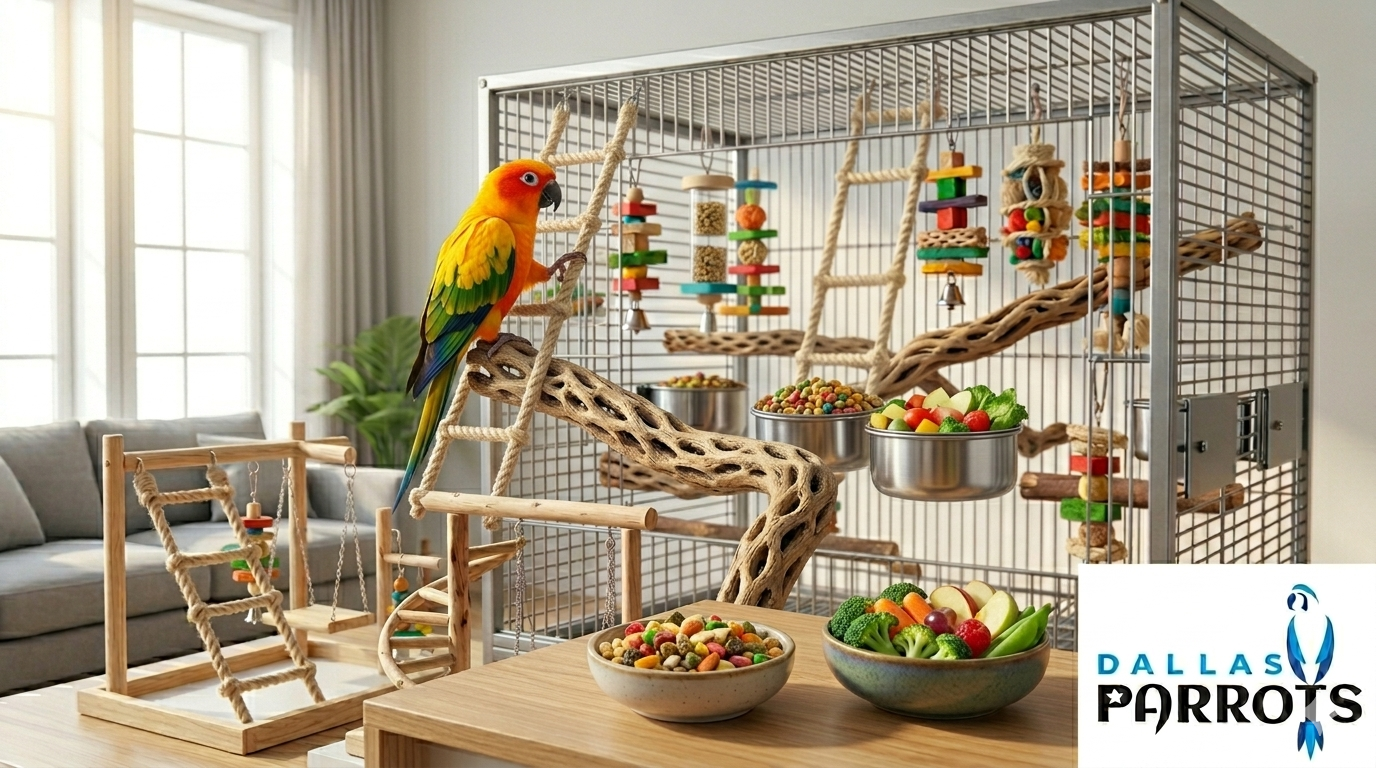
A good sun conure setup starts with the right cage. Minimum size for one bird is 24 by 24 by 30 inches. Bigger is always better. Bar spacing should be five-eighths to three-quarters of an inch so the bird can’t slip its head through.
| Spec | Minimum | Recommended |
|---|---|---|
| Width | 24 inches | 30+ inches |
| Depth | 24 inches | 24 inches |
| Height | 30 inches | 36+ inches |
| Bar spacing | 5/8 inch | 3/4 inch |
Inside the cage you want three or four perches at different heights and thicknesses made from safe natural wood. Add a rotating toy set including chew toys foraging puzzles and shreddable items. Stainless steel food and water bowls last longer and stay cleaner than plastic. A play stand outside the cage gives your bird a spot for supervised time.Keep the location away from the kitchen because nonstick pans release fumes that kill birds fast. Keep it away from drafty windows and direct AC vents too. Sun conures handle warm temps fine but they’re sensitive to sudden changes.
Sun Conure Talking Ability
Can sun conures talk? Some do but it’s not their strong suit. Sun conure talking ability tends to land around 10 to 30 words for the average bird. A few go higher but most stick to short phrases and whistles.Their voice sounds scratchy compared to larger parrots like african greys or quakers. They mimic environmental sounds better than clear speech. Microwave beeps phone rings door squeaks. So if talking is your main goal a sun conure probably isn’t the right choice. If you want a bird that talks clearly a quaker or african grey suits better.
Sun Conure vs Jenday Conure
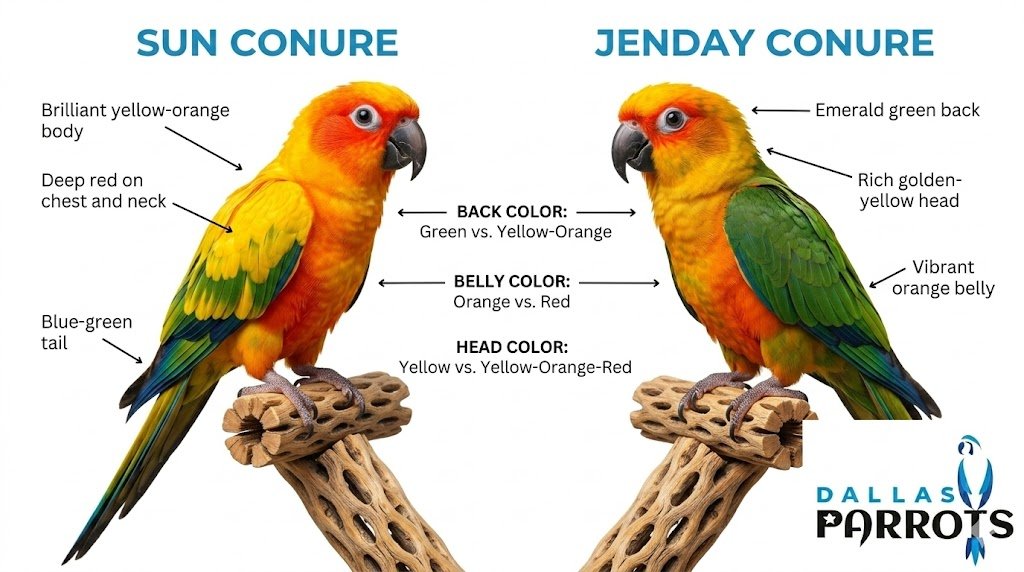
People mix these two up all the time and I get it. They look similar and they’re close cousins. But sun conure vs jenday is actually a useful comparison because the differences matter.uns have solid yellow bodies with orange chests and red highlights around the face. Jendays have green backs yellow heads and orange bellies. The green on the jenday is the fastest way to tell them apart. Sun conures are a bit larger and noticeably louder. Jendays tend to be gentler with softer voices.
| Feature | Sun Conure | Jenday Conure |
|---|---|---|
| Body color | Yellow orange red | Green back yellow orange front |
| Adult size | 12 inches | 11 to 12 inches |
| Volume | 120 dB screams | 100 dB screams |
| Price 2026 | 500 to 900 | 400 to 700 |
| Personality | Bold dominant | Calmer playful |
| Talking | 10 to 30 words | 10 to 20 words |
If you want more detail on the other species our jenday conure page goes deeper.
Step by Step Guide to Buying Your First Sun Conure
Here’s how I walk new buyers through the process.
- Research sun conure personality noise level and the 20 to 30 year commitment before anything else
- Budget 500 to 1500 dollars for the bird plus another 1000 to 1500 for first-year cage food and vet visits
- Find a verified breeder or adoption group and never buy an unweaned chick unless you have hand feeding experience
- Ask for DNA results hatch certificate health guarantee and diet history before you pay
- Set up the cage food and toys before the bird arrives so day one is smooth
- Schedule a vet exam within 30 days of bringing your bird home
- Start bonding slowly with target training and positive reinforcement
The key is to keep the bird active and feel safe from the first day. A stressed new bird screams more and bites more. Patience in those first weeks pays off for years.
Common Mistakes New Buyers Make
A few patterns I see over and over.People underestimate the noise and return the bird after a month. Others feed only seed mixes which leads to vitamin A deficiency and fatty liver disease. Some buy unweaned chicks hoping to bond faster and end up dealing with aspiration or crop issues. A lot of new owners skip the first avian vet visit thinking the bird looks healthy enough.Teflon and nonstick cookware in the kitchen is a silent killer. The fumes from an overheated pan can drop a bird before you smell smoke. Switch to stainless steel or cast iron when you’ve got a parrot in the house.And isolation. Keeping a highly social bird alone in a back room all day creates behavior problems fast.
Pro Tips From Dallas Parrots
- Mist bathe your bird two to three times a week for healthy feathers
- Schedule the first avian vet exam within 30 days of bringing the bird home
- Rotate foraging toys every 7 days to keep things fresh
- Start target training on day one even if the bird is still settling in
- Cover the cage at the same time each night for consistent sleep
Small things done consistently beat big effort done occasionally. The birds we hear back about years later almost always have owners who nailed these basics.
Why Choose Dallas Parrots for Sun Conures for Sale
Our sun conures for sale are hand fed and fully weaned before they go home. That’s not optional here.
- Every baby sun conure is hand raised from the nest
- Avian vet health checked before placement
- DNA sexed and paperwork included
- Transparent 2026 pricing with no hidden fees
- No shipping of unweaned chicks
- Lifetime care support through Dallas Parrots
- Verified breeder with years of conure experience
If you want to see currently available birds you can browse our sun conure bird for sale listings or look at our sun conure high red options if you’re after something rarer.
Benefits of Buying Your Sun Conure From Dallas Parrots
- Care sheet and diet notes go home with every bird
- First two weeks of transition support
- Avian vet referrals in your region
- 30 day health guarantee
- Access to rare mutations like high yellow and red factor
- Ongoing training consults when behavior questions come up
We also stay in contact after the sale. Call us text us email us. We don’t disappear once the bird leaves.
Real Customer Stories
Our sun conure Mango is 2 years old now and still as sweet as the day we brought her home from Dallas Parrots. Every step from pickup to setup was easy. Jessica R. Houston Texas
I researched sun conure price for months before I found Dallas Parrots. Fair pricing honest breeder and Kiwi has been a dream. He eats his pellet like a champ and talks to the dog. David L. San Diego California
We adopted a rehome sun conure and their team helped us with the screaming during the first few months. Now she is our best little friend. Maria P. Chicago Illinois
Stories like these are why we keep doing this work.